


Table of Contents
- Start Here: A Gentle Path to Smoother Skin
- AHA vs BHA for Blackheads and Other Skin Concerns
- How to Pick a Gentle Chemical Exfoliant for Sensitive Skin
- AHA BHA for Beginners: Patch Test and Start Slow
- How Often to Use AHA and BHA Without Over-Exfoliating
- Routine Compatibility: What to Pair and What to Avoid
- Building a Gentle AHA BHA Skincare Routine with Brume d'Avril
- Conclusion
- Frequently Asked Questions
Last Updated: October 19, 2026
Start Here: A Gentle Path to Smoother Skin
Many people who try chemical exfoliants stop using them early on. Not because the acids don't work, but because they start too strong, too often, or with the wrong acid for their skin. Learning how to choose gentle AHA BHA skincare comes down to three things: the right acid for your concern, a low concentration, and a slow start.
This guide from April Rains Enterprises walks you through all three, step by step.
First, a quick definition. AHA and BHA skincare refers to products built around alpha hydroxy acids and beta hydroxy acids, two groups of chemical exfoliants that loosen the bonds holding dead skin cells together.
Here's what most guides get wrong: they list acids by strength. For sensitive skin, strength is often the wrong measure, since tolerance can matter more. A mild lactic acid you can use twice a week may suit you better than a strong glycolic acid that leaves your face red and stinging, though results vary from person to person.
Below, we'll show you exactly how to read a label, patch test, build up frequency, and spot irritation before it becomes a problem.
AHA vs BHA for Blackheads and Other Skin Concerns
The short answer: AHAs work on the skin's surface, while BHAs work inside the pore. That single difference decides which one suits your concern.
Alpha hydroxy acids (AHAs) are water-soluble. They loosen dead skin cells on the surface, which helps with dullness, rough texture, and uneven tone. Common examples include glycolic acid and lactic acid.
Beta hydroxy acids (BHAs) are oil-soluble. They slip into the pore lining and help clear congestion, which makes them the better pick for blackheads and oily, breakout-prone skin. Salicylic acid is the best-known BHA.
For blackheads specifically, a BHA is usually the more direct choice. For dullness and dark spots, an AHA tends to do more.
| Concern | Better Acid | Why |
|---|---|---|
| Blackheads, clogged pores | BHA | Oil-soluble, reaches inside the pore |
| Oily, breakout-prone skin | BHA | Helps clear pore congestion |
| Dullness, rough texture | AHA | Loosens dead cells on the surface |
| Uneven tone, dark spots | AHA | Supports surface cell turnover |
| Fine lines | AHA | Works on surface texture |
| Dry, sensitive skin | Lactic acid (AHA) | Gentler than glycolic |
How to Pick a Gentle Chemical Exfoliant for Sensitive Skin
For sensitive or reactive skin, the goal is not to find the strongest acid you can tolerate. It is to find the mildest acid that still addresses your main concern, then introduce it slowly enough that your barrier stays intact. Use the framework below to narrow the field before you buy.
Step 1: Match the acid to your primary concern
Pick one concern first. Trying to treat blackheads, dullness, and fine lines at once is how people end up layering three acids and irritating their skin.
- Blackheads, clogged pores, oily breakouts: salicylic acid (BHA) is the more direct choice because it is oil-soluble and reaches inside the pore lining.
- Dullness, rough texture, uneven tone: lactic acid or mandelic acid (AHAs) are common gentle starting points. Lactic acid is often better tolerated than glycolic acid because its larger molecule penetrates more slowly.
- Dark spots and post-acne marks: an AHA such as lactic or mandelic acid supports surface cell turnover; pair it with daily sunscreen or the spots can darken again.
- Fine lines and overall texture: an AHA is the usual pick, but start at the low end of the concentration range.
- Dry and sensitive skin with congestion: a low-strength BHA used once a week is often better tolerated than a strong AHA, because the goal is pore clearing rather than surface resurfacing.
Step 2: Read concentration and pH together
Concentration tells you how much acid is in the bottle. pH tells you how much of that acid is in its active, exfoliating form. Both matter, and most shoppers check neither.
For a first leave-on exfoliant, look for single-digit concentrations at the low end of the brand's range. A common pattern among gentle formulas is roughly 5% lactic acid or 1-2% salicylic acid, but exact numbers vary by brand and format. Do not assume a higher percentage is more effective for your skin; it mainly raises the irritation risk.
pH matters because AHAs and BHAs only exfoliate within a certain acidic range. A well-formulated product at a sensible pH can do its job without a high percentage. If a label lists no pH at all, treat that as a missing detail rather than a green light. For a first purchase, a formula that states its pH and sits in a moderate acidic range is easier to evaluate than one that hides the number.
Step 3: Choose a format you can control
- Leave-on toners and serums are easy to dose and easy to stop, which makes them good first choices.
- Wash-off exfoliating cleansers are shorter-contact and often milder, but they are harder to judge because contact time varies.
- Peels and pads can be convenient but are easy to overuse; save them until you know how your skin responds to a basic leave-on.
Step 4: Screen the rest of the formula
Fragrance, essential oils, and drying alcohols are common irritants for reactive skin. A fragrance-free formula with barrier-supporting ingredients such as glycerin, panthenol, or squalane gives your skin fewer things to react to while you are still learning your tolerance.
Step 5: Buy small and commit to one
Buy the smallest size available. Use one exfoliant for at least four weeks before judging it. A common mistake is buying a starter set with several acids and using them all at once, which makes it impossible to tell what is working and what is irritating.
AHA BHA for Beginners: Patch Test and Start Slow
Patch test first, then start with one application per week. That schedule gives your skin time to tell you how it feels before you add more.
Here is the schedule we recommend:
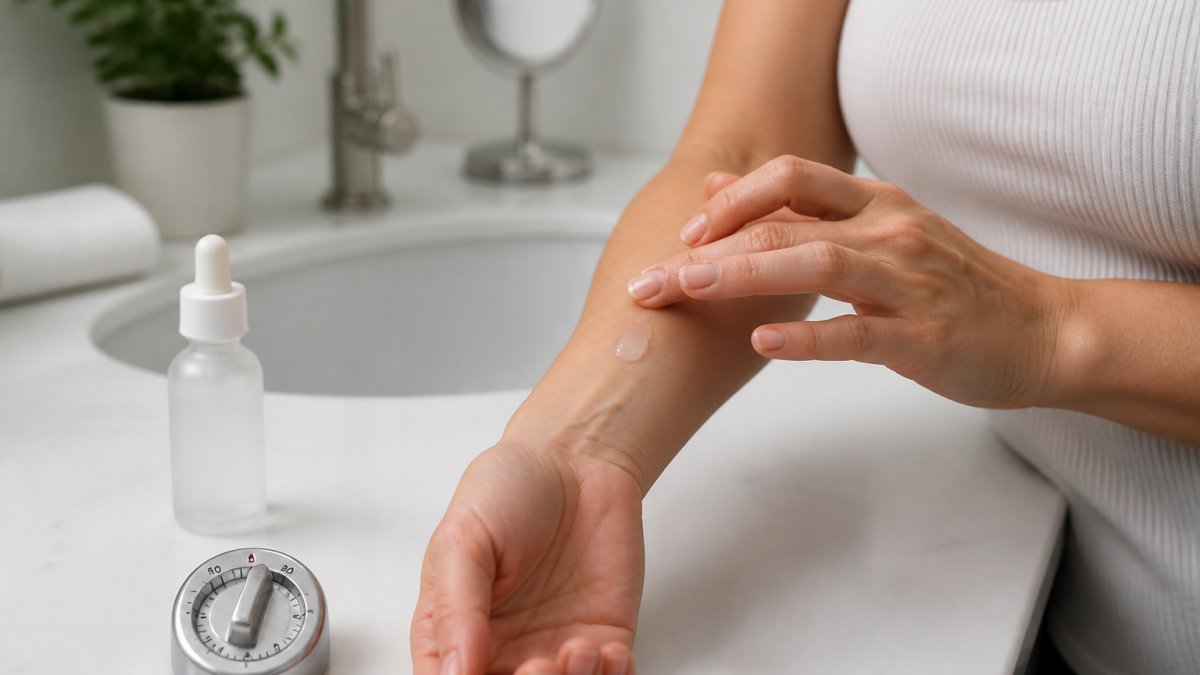
- Patch test. Apply a small amount to your inner forearm. Wait 24 hours. Check for redness, itching, or stinging.
- Week 1: One application on the face.
- Week 2: One application. If skin stays calm, add a second.
- Weeks 3-4: Two applications per week if tolerated.
- Week 5 onward: Increase only if skin is calm and comfortable.
Apply to dry skin at night, and follow with a plain moisturizer. Skip the exfoliant on any night your skin feels tight or warm.
What Irritation Looks Like and How to Back Off
Mild tingling for a minute or two is common for many people, though skin reacts differently from person to person. Stinging that lasts, redness, flaking, or a burning feeling are signs to stop.
Brume d'Avril Milky Oil Foaming Cleanser →
If you over-exfoliate:
- Stop all acids for 7 to 10 days
- Use only a gentle cleanser and a rich moisturizer
- Skip actives until skin feels normal again
- Restart at once a week when you return
How Often to Use AHA and BHA Without Over-Exfoliating
Twice a week is the ceiling for most beginners, and once a week is plenty for sensitive skin. More frequent use does not reliably speed up results. It just raises the odds of irritation.
Signs you are using it too often:
- Skin stings when you apply moisturizer
- Redness that lingers past an hour
- Flaking or tightness in the morning
- New breakouts in unusual spots
If any of those show up, cut back to once a week. Skin does not typically build tolerance faster by pushing through.
Also, avoid layering an AHA and a BHA on the same night as a beginner. Alternate them on different days, or pick one and stick with it.
Routine Compatibility: What to Pair and What to Avoid
Keep your routine simple around an exfoliant: cleanse, exfoliate, moisturize, protect. That is it.
Pair with:
- A gentle cleanser, like the Brume d'Avril Milky Oil Foaming Cleanser
- A gentle moisturizer, like the Brume d'Avril Pro-Aging Nourishing Face Cream
- Sunscreen every morning, no exceptions
Avoid on the same night:


- Retinol or other strong actives
- Scrubs and physical exfoliants
- Anything with a strong fragrance
Sun protection matters most. Exfoliated skin is more sensitive to sunlight, so a daily sunscreen is not optional. The American Academy of Dermatology sun protection guidance recommends broad-spectrum sunscreen every day.
Building a Gentle AHA BHA Skincare Routine with Brume d'Avril
A gentle routine works best when the supporting steps are gentle too. Harsh cleansing can undo the progress an exfoliant makes.
At April Rains Enterprises, we built the Brume d'Avril line around that idea.
Your simple routine:
- Morning: Cleanse, moisturize, sunscreen
- Exfoliant nights: Cleanse, apply exfoliant to dry skin, moisturize
- Other nights: Cleanse, moisturize
Conclusion
Picking a gentle exfoliant is harder than it should be, and most people learn by irritating their skin first. You don't have to.
Start with one acid that matches your concern, patch test it, and build up slowly. If you want a routine where every step supports your skin barrier, explore the Brume d'Avril line at April Rains Enterprises. Our cleanser and moisturizer can help support your skin barrier during exfoliation.
Frequently Asked Questions
What is a good chemical exfoliant for sensitive skin?
A good gentle chemical exfoliant for sensitive skin uses a low concentration of a mild acid, such as lactic acid or mandelic acid, and sits at a skin-friendly pH around 3.5 to 4. Start with a leave-on formula once or twice a week, patch test first, and watch for redness or stinging. Avoid daily use and high percentages until your skin builds tolerance. A supportive cleanser and moisturizer, like Brume d'Avril's Milky Oil Foaming Cleanser and Pro-Aging Nourishing Face Cream, can help keep your barrier comfortable while you introduce an exfoliant.
Which is better for blackheads, AHA or BHA?
BHA, usually salicylic acid, is generally better for blackheads because it is oil-soluble and can travel into pores to help loosen trapped oil and dead skin cells. AHAs work mainly on the skin's surface and are better for texture, dullness, and uneven tone. If blackheads are your main concern, look for a gentle BHA at 1 to 2 percent. If you also want smoother surface texture, you can use a mild AHA on alternate days once your skin has adjusted.
Is it okay to use AHA and BHA every day?
Daily use of AHA and BHA is too much for most beginners and for many people with sensitive skin. Start with one or two applications per week, then increase slowly only if your skin stays comfortable. Signs that you are overdoing it include redness, stinging, flaking, and tightness. If those appear, stop the exfoliant for a week and focus on gentle cleansing and moisturizing. Once your skin settles, you can try alternate-day use, but daily use should be reserved for tolerant skin and mild formulas.
Can you use AHA and BHA in the same skincare routine?
Yes, you can use AHA and BHA in the same routine, but beginners should not layer them on the same day. A safer approach is to use a BHA on one day and an AHA on another, with rest days in between. Some formulas combine both acids at low strengths, which can be convenient if your skin is already tolerant. Always patch test a new combination and introduce one product at a time so you can tell what works. Pair exfoliation with sunscreen every morning, because acids can make skin more sensitive to the sun.


